 Ace Hybrid Tech | Hybrid battery replacement
The hybrid battery system in the Toyota Prius is engineered for long-term durability, but like all electrochemical systems, it degrades over time. Recognizing early-stage failure patterns is critical—not only to avoid unexpected breakdowns, but also to reduce long-term repair costs and preserve vehicle efficiency.
At Ace Hybrid Tech, we diagnose Prius battery systems daily. What most drivers interpret as “sudden failure” is almost always a gradual imbalance at the module or cell level. This guide outlines the real-world failure signatures we see in the field, backed by diagnostic patterns rather than generic assumptions.

Understanding How Prius Battery Degradation Occurs
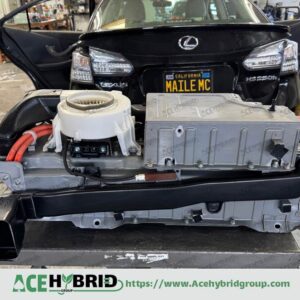
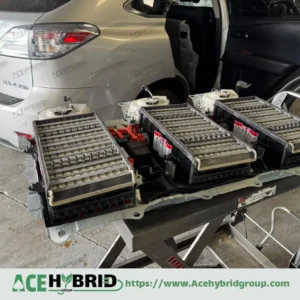
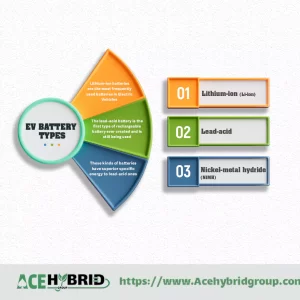
The Prius hybrid battery pack—typically Nickel-Metal Hydride (NiMH) in most generations—operates as a series of modules. Over time, these modules do not degrade uniformly. Instead, internal resistance increases unevenly, leading to voltage deviations under load.
This imbalance is the root cause behind nearly all observable failure symptoms.
From a diagnostic standpoint, failure is rarely binary (working vs dead). It is progressive and measurable across three key parameters:
- Voltage stability under load
- Charge acceptance rate
- Thermal behavior
When one or more modules fall outside expected thresholds, the Battery Management System compensates—until it no longer can.
The Most Reliable Signs of Toyota Prius Battery Failure
Abnormal State-of-Charge Fluctuation
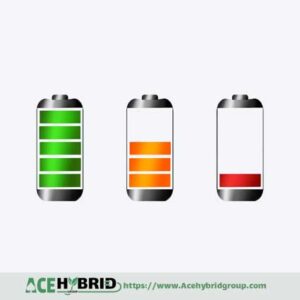
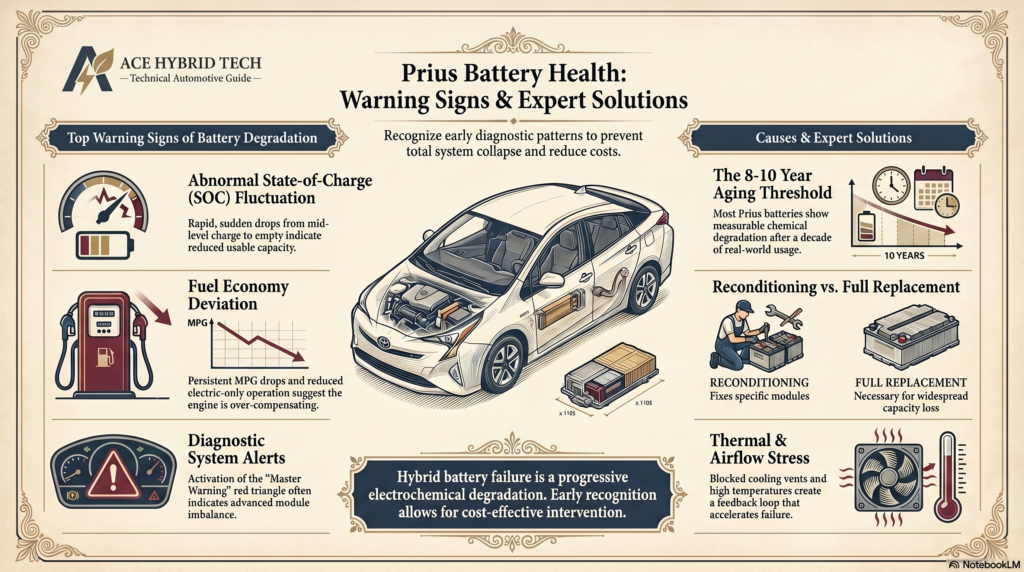
One of the earliest and most technically telling signs is rapid fluctuation in the battery’s state-of-charge (SOC).
Under normal conditions, SOC transitions are gradual. However, when module imbalance develops, the system misinterprets available capacity. This results in:
- Sudden drops from mid-level charge to near empty
- Rapid recharging cycles within short driving intervals
This behavior reflects reduced usable capacity rather than total battery failure.
Let’s Talk Hybrid Solutions!
Contact Ace Hybrid Tech for professional service and support.
Increased Internal Resistance and Load Instability
Drivers may not directly measure internal resistance, but its effects are noticeable. Under acceleration, the battery struggles to deliver consistent current, forcing the internal combustion engine to compensate.
This manifests as:
- Hesitation during throttle input
- Reduced electric assist
- Engine over-engagement in low-speed conditions
From a technical perspective, this indicates that the battery can no longer sustain load demands efficiently.
Diagnostic Trouble Codes and System Alerts
As degradation progresses, the vehicle’s onboard diagnostics system begins to detect anomalies. In the Toyota Prius, this typically includes:
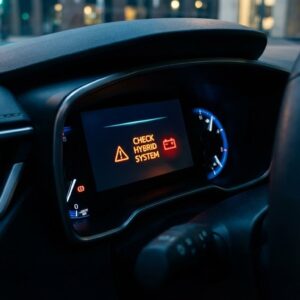
- Hybrid system warnings
- Check engine light activation
- Master warning indicator (commonly referred to as the red triangle)
The most common stored fault relates to battery block imbalance or voltage irregularities. However, relying solely on fault codes is insufficient—by the time codes appear, degradation is already advanced.
Thermal Irregularities and Cooling System Overactivity
Battery efficiency is closely tied to temperature control. As internal resistance rises, so does heat generation.
In real-world diagnostics, this leads to:
- Cooling fan operating at higher speeds more frequently
- Audible airflow from rear cabin vents
- Uneven temperature distribution across modules
Excessive heat further accelerates degradation, creating a feedback loop that worsens battery condition.
Fuel Economy Deviation Beyond Expected Range
A properly functioning hybrid system optimizes the balance between electric and combustion power. When the battery becomes inefficient, the system compensates by increasing engine usage.
Unlike minor MPG variations, battery-related inefficiency is characterized by:
- Persistent fuel consumption increase
- Reduced electric-only operation
- Shortened EV driving intervals
This is often one of the first signs noticed by experienced Prius drivers.
Reduced Regenerative Braking Efficiency
Regenerative braking relies on the battery’s ability to accept charge quickly. A degraded battery loses this capability.
Technically, this is due to:
- Lower charge acceptance rate
- Voltage spikes during regeneration
As a result, energy that would normally be captured is instead lost, reducing overall system efficiency.
Why These Failures Occur: Field Insights from Ace Hybrid Tech
In controlled conditions, Prius batteries are highly durable. However, real-world usage introduces stress factors that accelerate degradation.
The most significant contributors we observe include prolonged exposure to elevated ambient temperatures, which increases chemical breakdown inside battery cells. Urban driving with frequent short trips can also contribute, as the battery cycles more often without reaching optimal operating conditions.
Another overlooked factor is restricted airflow in the battery cooling system. Dust accumulation or blocked vents can significantly increase operating temperature, particularly in older vehicles.
Finally, age remains a dominant variable. Even under ideal conditions, chemical aging reduces capacity over time. Most Prius batteries begin to show measurable degradation after 8–10 years of use.
Repair vs Replacement: A Technical Perspective
One of the most common misconceptions is that battery failure always requires full replacement. In reality, the appropriate solution depends on the extent of module imbalance.
Reconditioning may be viable when:
- Degradation is limited to a small number of modules
- Voltage deviation is still within recoverable range
However, this approach addresses symptoms rather than root aging. It can restore performance temporarily but does not reset overall battery lifespan.
Full replacement becomes necessary when:
- Capacity loss is widespread
- Internal resistance is consistently high across modules
- Thermal instability is present
At Ace Hybrid Tech, we base this decision on diagnostic data—not assumptions—ensuring that customers receive the most cost-effective long-term solution.
When to Take Action
Battery failure is rarely sudden. The warning signs outlined above typically appear weeks or months before critical failure.
The key is timing.
Early intervention allows for:
- Lower repair costs
- Greater likelihood of successful reconditioning
- Prevention of secondary system strain
Delaying diagnosis, on the other hand, often leads to complete battery collapse and higher replacement costs.
The hybrid system in the Toyota Prius is highly sophisticated, and battery failure should never be approached with guesswork. What may appear as a minor performance issue can reflect deeper electrochemical imbalance within the battery pack.
At Ace Hybrid Tech, our approach is rooted in data-driven diagnostics, allowing us to identify failure patterns early and recommend the most effective solution—whether that involves targeted repair or full replacement.
If your Prius is showing any of the behaviors described above, a professional diagnostic evaluation is the next logical step.
Ace Hybrid Tech provides advanced hybrid battery testing and repair solutions designed to identify issues before they become critical failures.
Let’s Talk Hybrid Solutions!
Contact Ace Hybrid Tech for professional service and support.